Maybe you’ve been reading about WordPress and somewhere along the way you hit a headline about some trouble with the platform: a lawsuit, a feud, or some impending crisis. Perhaps this has you reasonably concerned: should you put your money on running your website using a platform that’s at-risk? At the core is this question: Who owns WordPress, and can they take it away from me?
The short answer is that nobody owns WordPress, four different parties own four different pieces of it, and only one of those pieces is anything you depend on. By the end of this you’ll know which piece is which, what you own outright, and what precautions are worth taking to minimize your risk.
WordPress isn’t one thing. It’s five
Almost every confusing thing you’ll read about WordPress ownership comes from mixing up five separate things that share a name.
The software is the code that runs your website. It’s released under a license called the GPL, which is what “open source” means in practice here: anyone can download it, use it, change it, and even sell their changed version, forever. A license like that can’t be revoked. Once code is released under the GPL, it stays released.
The name is a trademark — the word WordPress and the logo. Trademarks are ordinary property, and somebody does own this one.
WordPress.org is a website. It hosts the download, the plugin and theme directories, the support forums, and — the part that matters most to you — the servers your site quietly contacts when it checks for updates. It is not the software. It’s the shop the software collects its parts from.
Your site is the WordPress files on your hosting account, your database, your uploads, your content, and your domain name.
WordPress.com is a commercial hosting product, owned and run by Automattic, that is built on the software and carries the name. It is not the project, it is not where the free software lives, and it is the one most people meet first. It gets its own section below, because it causes more confusion than the other four combined.
Five things, one name. Now the ownership question actually has answers.
So who owns each layer?
| WordPress layer | Who owns it? | Can it be taken from you? |
|---|---|---|
| The software | Nobody, or everybody. It’s GPL licensed and in the public domain | No. The GPL license is irrevocable |
| The name and logo | The WordPress Foundation, a non-profit | Not relevant to you unless you build a product called that |
| WordPress.org | Matt Mullenweg claims he owns this personally. This question is still being litigated | Access to it can be interrupted, which could affect you |
| WordPress.com | Automattic, Matt Mullenweg’s multi-billion-dollar company | This service could go away. That might be a good thing |
| Your website built on WP | You | No |
Two of those rows surprise people.
The first is that the Foundation, the non-profit set up to hold WordPress in trust for the public, owns the name but not the website. Its own trademark policy is blunt about the commercial side: if you want to use the WordPress trademark commercially, you’re told to contact Automattic, because Automattic has the exclusive license.
The second is that WordPress.org — the site nearly everyone assumes is the official, community-owned home of the project — has never been Foundation property. That gap between what people assumed and how it’s actually held is the seed of every argument in the next section.
The one that trips everyone: WordPress.com
Ask most people to name the thing called WordPress and they’ll picture wordpress.com, because that’s what a search for “WordPress” tends to put in front of you and it’s where a beginner usually lands first. It is a good product. It is also a commercial hosting service owned by Automattic, and it is not the WordPress that the rest of this article is about.
The practical differences, in the order they’ll bite you:
- You’re renting, not owning. Your site lives inside Automattic’s product. That’s a normal arrangement — it’s what Squarespace and Wix are too — but it’s the opposite of the self-hosted setup where the files are yours.
- The free tier is advertising-supported. WordPress.com shows its own ads on free sites, and you don’t control or earn from them. Your address is a wordpress.com subdomain.
- Plugins are a paid feature. Installing your own plugins requires a paid plan. On a self-hosted site, plugin installs are simply part of WordPress.
- The dashboard is not quite the dashboard. Tutorials written for self-hosted WordPress — including most of the ones here — will sometimes describe a screen you don’t have.
Now the part nobody writes down. The two names have been colliding for two decades, and the collision has never been cleaned up.
The Foundation’s own trademark policy asks the public not to use the abbreviation WP in ways that confuse people, and singles out the fact that many readers assume WP Engine means WordPress Engine. That’s a reasonable concern. It also sits oddly next to the fact that the single most confusing use of the full name belongs to the trademark’s exclusive commercial licensee, in the form of a product that shares a name with the open-source project it’s built on.
I’m not going to tell you what anyone intended by that. But it’s worth naming the incentive plainly: of everyone in a position to fix the confusion, none of them loses anything by leaving it in place, and at least one of them gains a steady supply of people who sign up believing they’re using the official WordPress because in a sense they are. The person who pays for the ambiguity is the beginner who picks the wrong one and finds out eighteen months later, when they want a plugin, or their own domain, or their files.
Which one should you use? If you want to learn WordPress properly, own your files, and install whatever you like, you want the self-hosted version — that’s what getting a domain and hosting sets up, and it’s what this site teaches. If you want somebody else to handle every technical thing and you’re content inside their product, WordPress.com is a fair choice, as long as you’re choosing it knowingly rather than because it was the first result.
Why anyone argues about this
WordPress runs a bit over 40% of all websites, which means a free, unownable piece of software sits underneath an enormous amount of money. Hosting companies, agencies, plugin businesses and marketplaces all built real revenue on top of code they pay nothing for. That’s exactly what the GPL is for, and for two decades it worked without much drama.
The friction shows up at the two layers that are owned. The trademark decides who may call their product WordPress-anything. WordPress.org decides whose plugins are listed, whose customers get updates, and who is inside the ecosystem at all. Neither of those is held by the non-profit, and both are ultimately controlled by the same person who runs the largest commercial company in the ecosystem.
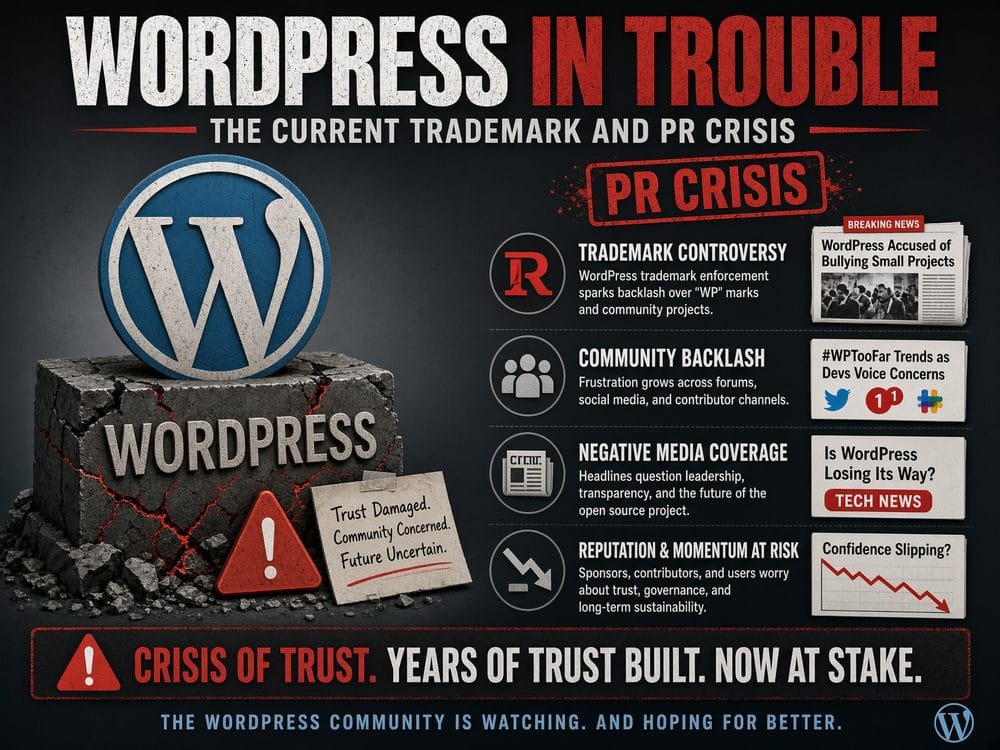
In September 2024 that arrangement came apart in public. Mullenweg criticized the hosting company WP Engine over its trademark use and its level of contribution to the project; WordPress.org cut off WP Engine’s access days later; WP Engine sued; and in December 2024 a federal judge ordered that access restored while the case proceeds. The litigation is still going as of late 2026, and it now includes arguments about who really controls WordPress.org and the trademarks.
You do not need to follow any of that, and this article is deliberately not a scorecard for it. What matters is the structural fact it exposed, which was true before the dispute and is still true after it: one layer of the WordPress world is a single point of control, and that layer is the one your site talks to for updates.
What it actually means for your site
Here’s the part nobody writes down.
Your site is yours, unambiguously. The files on your hosting account, the database, your posts, your images, your theme, your domain. No dispute at any other layer touches them. Nobody can reach into your hosting account, and no ruling in any lawsuit can un-GPL the copy of WordPress already installed there.
Nothing in the dispute has ever stopped a website from serving pages. When access was cut off in 2024, affected sites kept running. What broke was the convenient part — one-click updates and one-click plugin installs from the directory.
That convenience is your one real dependency, and it’s worth two small habits:
- Keep your own backups, stored somewhere other than your hosting account. This is good practice for a dozen unrelated reasons; the ownership question is just one more.
- Know where each of your plugins comes from. A plugin from a company with its own site and its own update server is not dependent on the directory. If a manual install is ever the fastest route back, installing WordPress by hand is a twenty-minute job, not a crisis.
And you can always leave. Your content exports, your site is portable between hosts, and the GPL guarantees the software goes with you. That’s a meaningfully different position from a hosted platform where your site exists only inside one company’s product. The ownership tangle above is the price of an ecosystem where nobody can lock the door — the same openness that makes WordPress worth arguing over is what makes it impossible for anyone to take it from you.
So: is WordPress in trouble? The institutions around WordPress are having an argument that’s genuinely unresolved. The software under your site is not in trouble at all, and neither is your site.