
Today’s blog entry is a history lesson without any practical application to WordPress today. We discuss the WordPress origin story, which took place over two decades ago. If our story had taken place in the distant past, a myth could have evolved around WordPress’ invention, something to entertain the public and obfuscate the idea that inventions rarely result from a lone genius’s “Eureka!” moment.
Our invention in question was a blogging tool and its co-creator a consummate blogger himself, a man who left a clear record of his product’s genesis. We are left to reckon with the fact that WordPress was developed to solve a rather ordinary business problem, and that it wasn’t especially exceptional itself, at first. But it was released with extraordinarily lucky timing, and engaged the community in a way that was innovative and crucial to its adoption, leading it to become a dominant force on the internet today.
Matt Mullenweg: right place at the right time
There are many reasons for WordPress’s success, but perhaps none more important than the precise moment our story occurs: when blogging was primed to explode back in 2003. The person most often credited with WordPress’s creation, of course, is the CEO of Automattic, Matt Mullenweg, who was a blogging early adopter (when it was still referred to as weblogging). In those days he used a tool called b2/cafelog, which he was happy using until he started to get serious traffic to his website and realized his tool had been languishing for some time, and had been all but abandoned by its developer.
Luckily for Mullenweg, b2/cafelog was open-source, which put it in the public domain. Open-source software varies a bit depending on the type of license chosen by its creators, and the one utilized by b2/cafelog was a GNU General Public License (GPL) version 2, which is a strong “copyleft” license. Mullenweg, under this license, would be permitted to use the b2/cafelog code as a springboard for new software, and that’s what he planned to do.
Mullenweg’s blog currently resides on his personal domain name ma.tt. Mullenweg has been treating it as an archival record, so anyone who wants the history of WordPress can go right to the “horse’s mouth” as they say and get his take on events in the company’s past. He’s not always been a prolific recorder of the company’s milestones, but he’s been consistent.
The blog entries regarding the origin of WordPress begin on January 24, 2003 with an entry titled, “The Blogging Software Dilemma” in which Mullenweg complained about the missing b2/cafelog developer and his plan to create a fork of it (think of a fork in the road) that he promised would have “the flexibility of Movable Type, the parsing of Text Pattern, the hack-ability of b2, and the ease of setup of Blogger.”
Mullenweg didn’t request assistance with the project, but a reader of his blog offered to help out nonetheless. That person was programmer Mike Little from England. As co-creator of WordPress, Little deserves as much credit as Mullenweg for creating WordPress, but he doesn’t often receive it. Mullenweg and Little began working on the new blogging tool in 2003, remotely and asynchronously, as the situation mandated.

Introducing WordPress
Mullenweg and Little released WordPress 0.7 mere months after beginning the project (note that this website took longer to build than the initial version of the platform it is built upon). The WordPress name came courtesy of Mullenweg’s friend Christine Selleck Tremoulet. The exact date of release was May 27, 2003. On that date, Mullenweg couldn’t even drink a beer to celebrate, legally, in the U.S. He was just 19 years old.
WordPress was well received by the blogging community. It was a fairly simple blogging tool but in that simplicity lie one of its strengths: WordPress was very easy to use and learn. It wasn’t until WordPress version 1.2, however, that the software began to really get noticed. That version introduced the plugins engine, which allows the platform to be extended in almost any way imaginable. It turns out that a blogging platform — static web pages combined with a dynamically-generated blog — is a remarkably versatile foundation for a website. It can be the basis for many different use cases, up to and including a fully functioning e-commerce store. Plugins make that possible.
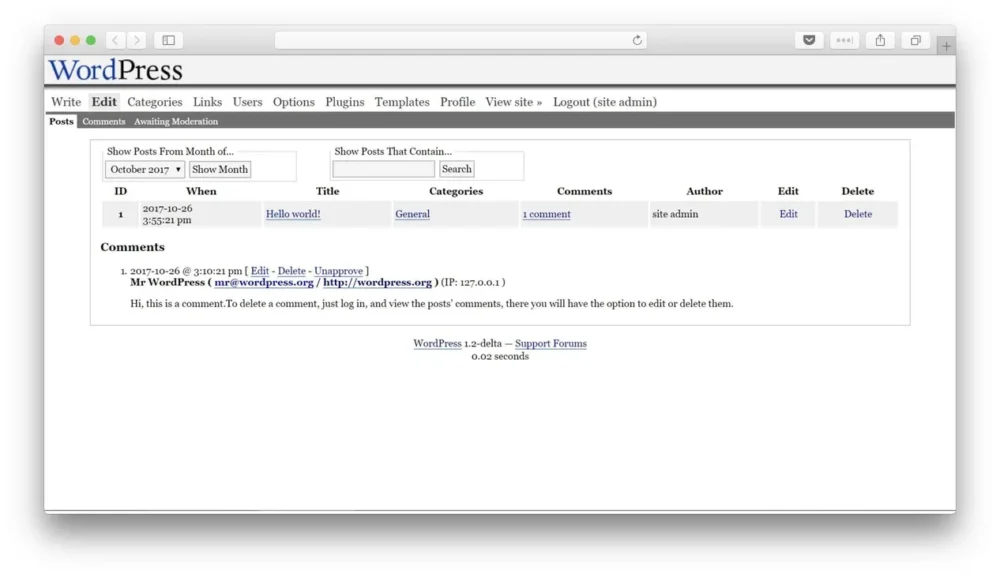
WordPress 1.2 didn’t just introduce the plugin engine. It also opened up plugin development to the entire WordPress community. WordPress’s every user became a potential collaborator in its development. This fostered excitement and generated buzz. Accordingly, adoption of WordPress began to skyrocket.
As more people became involved in developing WordPress, the software naturally got better. Version 1.5 introduced themes, downloadable add-ons that change the look and feel of an entire website without requiring any coding. Like plugins, themes were open to development by anyone, guaranteeing that the upward trajectory in WordPress’s adoption would continue.
With the introduction of the themes functionality, all of the elements were in place that today are credited with making WordPress a success:
- themes,
- plugins,
- open-source development model,
- low cost,
- simplicity,
- extensibility, and
- engaged user community.
The media loved the story of WordPress, as long as Mullenweg was the focus. His young age provided a human-interest “boy wonder” angle to what would have otherwise been a dry, technical story about open-source software and blogging infrastructure. Mullenweg was often dubbed a “wunderkind” and “prodigy” even though it was clear he was just an average computer nerd who was in the right place at the right time.
The jury’s still out on Mullenweg and Automattic
Post-WordPress’s release, Mullenweg founded Automattic Inc., which he claimed was to support the WordPress community by creating tools that support WordPress (Automattic created anti-spam plugin Akismet and owns Woo Commerce). Notably, Mullenweg didn’t ask Little to join the company, a snub that Little has never expressed resentment for. Little says he has been more interested in the open-source community than the creation of corporate and personal wealth. Today, public discourse is sharply divided over whether Mullenweg and Automattic are protecting WordPress or destroying it. You can read more about this in our article on the differences between WordPress and WordPress.com.